


Women in Dairy - Kay-Marie Swart
South Africa has a long-standing love affair with dairy, and milk production is one of the country’s largest agricultural sectors. There are well over a million dairy cattle in the pastures, producing more than 3 billion litres of milk annually to meet the needs of South African consumers. In addition, it is estimated that the dairy industry provides employment for around 80 000 South Africans on farms and at dairy production facilities, and many of these are women.
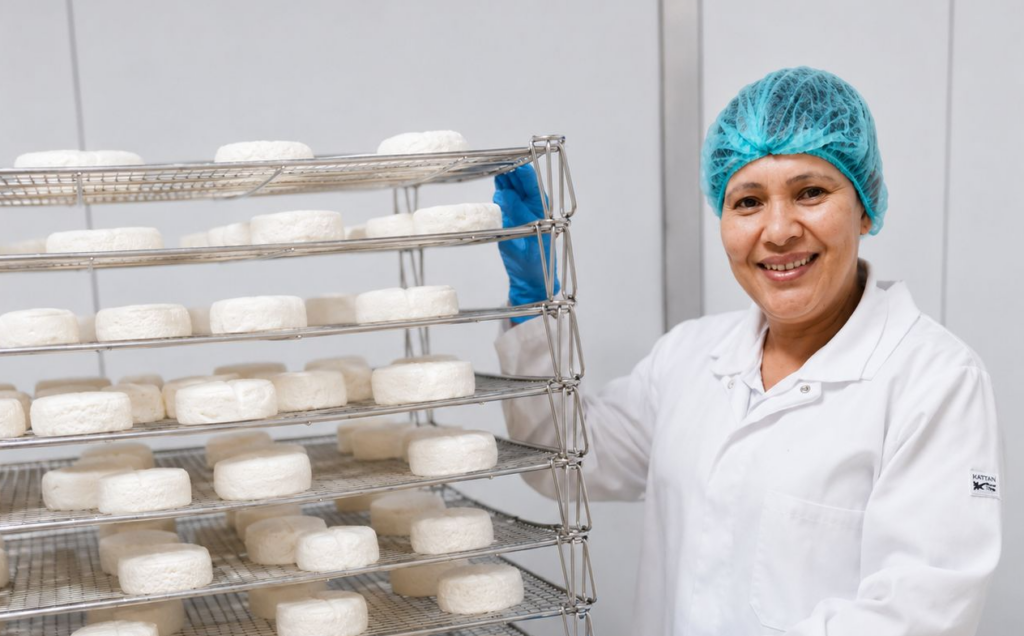
From farms to artisanal cheeseries and large production facilities, women are playing key roles in getting a wide range of dairy products onto our kitchen tables every day. Among them is Kay-Marie Swart, cheesemaker at Stonehouse Cheese Estate outside Stanford, where hand-crafted cheeses are made using milk from the farm’s resident Jersey dairy herd.
For Kay-Marie, her journey into cheesemaking began long before she ever stepped into a cheese room. “My interest in dairy started with bottle-feeding calves on a farm,” she says. “From there, I moved into learning the fundamentals of caring for the animals and milking cows myself. It was humble work, but it taught me the importance of milk quality and what goes into producing milk well.”
In 2016, Stonehouse Estate established its own cheese factory, creating an opportunity for Kay-Marie to move into cheesemaking. “I joined as Assistant Cheesemaker working under then Head Cheesemaker, Andre Kruger,” she explains. “That’s how I learned the craft – from hand-cutting curd to ageing and flavour development, using both traditional methods and stabilised white mould techniques to ensure consistency and quality.”
Today, Kay-Marie leads the production of a range of cheeses that includes soft white mould cheeses like Camembert and Brie, hard aged cheeses such as Pecorino, Boerenkaas and Bergkaas, as well as semi-hard cheeses including Cajun, Italian Herb, Black Pepper and Garlic & Chives. Over the years, several Stonehouse Estate cheeses have been winners at the South African Dairy Championships.
“In May this year, we celebrated a decade since the opening of Stonehouse Cheese Factory,” she says. “What began for me as caring for calves has grown into a full farm-to-cheese operation. Every step, from production to the cheeseboard, is done by hand and with care.”
Why South Africa’s women in dairy deserve recognition
Kay-Marie says she has seen significant change in the dairy industry over the past decade, particularly within artisanal cheesemaking. “It used to be a typically male-dominated, old-school role,” she says. “But there has been a real shift over the last 10 to 15 years. Today, a lot of the small-batch artisan cheese movement is being driven by women.”
She says women are increasingly leading in areas such as microbiology, ageing control and flavour development. “The progress I have noticed includes more women owning their own dairies,” she says. “There has also been a push for better equipment such as designing ageing racks and vats that are ergonomically built for smaller frames.”
Kay-Marie encourages younger women interested in dairy careers to embrace both the scientific and business aspects of the industry. “Go for it, but go in with both your hands and your head,” she says. “Learn the science of cheesemaking, not just the traditions. Start small and hands on. But also, don’t underestimate the importance of the business side. The people succeeding in artisanal cheese today are those who treat it as a proper business, not just a craft.”
She also hopes to leave behind a legacy of mentorship and quality craftsmanship. “I want my legacy to be that I helped prove that cheese can be made with skill, care and integrity right here on the farm – and that women belong at the heart of the craft,” she says. “This is why I am currently training others – so the craft doesn’t stop with me.”
The art and science behind cheesemaking
At Stonehouse Cheese Estate, Kay-Marie begins each week by planning production schedules and checking stock in the cold rooms before moving into the physical work of cheesemaking.
“My days are filled with heating the milk, adding the culture and rennet, cutting the curd by hand and draining it,” she explains. “It’s mostly hands-on work and timing is crucial – although experience teaches you to feel when the curd is ready rather than watching a clock.”
She says cheesemaking requires balancing scientific precision with instinct developed through experience. “The science is what keeps you from messing up, and the art is what makes the cheese good,” she says. “I track everything I do so that I learn and am able to repeat what works well. Science keeps the cheese safe, and my senses make it great.”
For Kay-Marie, the most fascinating part of cheesemaking happens during the ageing process. “The wheels in the maturing room are essentially living products,” she says. “The rinds develop their own ecosystem of moulds and bacteria, and the interior of the wheel transforms on its own timeline.”
“You can control the temperature and the humidity, but you can’t force it,” she adds. “That’s when milk stops being milk and becomes something with depth and history.”
Why sustainability matters in dairy
Like many sectors within agriculture, dairy farming and production depend heavily on natural resources, making sustainability increasingly important for the future of the South African dairy industry.
Kay-Marie says, “Dairy starts with cows, land, water and energy, so the footprint of a dairy product like cheese can add up quickly,”
She explains that healthy land and healthy cows ultimately produce better quality milk and therefore, better cheese. “Dairy farming depends entirely on healthy land and water systems. If we don’t protect those resources, there is no future for milk production – or cheesemaking.”
Stonehouse Cheese Estate incorporates sustainability practices across the farm and cheesery operation. These include rotational grazing for the Jersey herd, water catchment systems, efficient irrigation, and maintaining the natural wetlands around the farm to protect local water systems.
The farm also follows a full farm-to-cheese approach by using leftover whey from cheesemaking to feed their pigs.
Bringing cheese to the table
Kay-Marie says one of the greatest rewards is seeing people enjoy cheese in simple, everyday ways.
One of the cheeses she is most proud of is Stonehouse’s stabilised Camembert. “The flavour develops more slowly and more evenly,” she explains. “You still get those mushroomy notes, but it is cleaner and more buttery rather than overwhelming.”
And her favourite ways to enjoy cheese?
- Baked camembert drizzled with honey and herbs
- Soft cheese whipped into a savoury spread for sourdough toast
- And, good cheese simply folded through hot pasta with black pepper and a little pasta water to create a simple creamy sauce
“You want to let the cheese be the hero ingredient, not an add-on,” she says.
For Kay-Marie, every wheel of cheese tells a story of the land, the animals and the people behind it – stories she hopes will continue for generations to come.